A good backtest starts the questions, it does not end them
How to distinguish an attractive backtest from a result that is reproducible, robust and investable after costs.
On 31 July 2026, the FTSE Global All Cap Index contained 10,127 stocks from around the world. Yet 61.97 % of its value was in the United States, 31.59 % in the technology industry and 21.61 % in only its ten largest companies (source: FTSE Russell, data as at 31 July 2026). More than ten thousand securities, but still a pronounced weight in one country, one industry and a handful of giants.
FTSE Global All Cap, as at 31 July 2026
10,127 stocks
61.97 % of value in the United States
31.59 % in the technology industry
21.61 % in the ten largest companies
Source: FTSE Russell
This is not an argument against broad index funds. Such a fund performs its job very well, as we will return to later. It is a reminder that breadth and concentration can coexist, and that the number of investments tells us little by itself. To judge diversification, ask what the portfolio holds, at what weights and how those investments move together.
The risk of an equity investment can be divided into two parts. The first belongs to one company: a failed product, a lost lawsuit, accounting fraud or a bad acquisition. The second is shared across stocks: recession, higher interest rates or a broad retreat by investors.
Diversification works only on the first part. If a portfolio holds thirty companies rather than one, a bad event at one company moves the portfolio less because positive and negative surprises average out. Diversification does not remove common market risk. When the whole market falls, companies fall together and averaging does not help. A diversified portfolio is not a safe portfolio. It is a portfolio without unnecessary single-company risk. A very concentrated portfolio can suffer a loss from one failed idea that a market recovery never repairs.
Consider a simple model. All positions are equal in size, the companies have similar volatility and their company-specific shocks are independent. In that model, the volatility of remaining company-specific risk falls roughly in proportion to one divided by the square root of the number of stocks. With 25 stocks, about 20 % of the volatility carried by one stock remains. With 30, about 18.3 % remains. The thirty-first stock lowers that figure from 18.3 % to about 18.0 %. The first additions do most of the work and each later one contributes less. This is an illustration within a model, not a promise for a real portfolio.
Harry Markowitz wrote in his original 1952 portfolio-selection paper that the number of securities is not enough. Portfolio risk also depends on weights and on how investments move together. His example was a portfolio of many railway stocks, which is less diversified than a smaller portfolio spread across different industries.
Research has never established one correct number. Evans and Archer showed in 1968 that volatility in randomly assembled portfolios stopped falling noticeably after a small number of stocks. Later literature usually summarises their result as roughly 8 to 10. In 1987, Statman compared benefits and costs and moved the threshold to at least 30 to 40. Campbell and co-authors showed in 2000 that the required number increased between 1962 and 1997 because individual companies became more volatile. In a 2007 simulation using large US stocks, Domian and co-authors calculated that the risk of a poor outcome over twenty years continued to fall beyond 100 stocks. The answer depends on which risk we measure and how much residual risk we accept.
Practitioners are similarly cautious. Wesley Gray describes concentration as a trade-off. More holdings reduce single-company risk, but also dilute the effect of selection if that selection has any value. Chen and Israelov warn from another direction. Portfolios with similar average volatility can finish in very different places over time because selection luck matters too. Morgan Housel notes that a small minority of exceptional companies often creates much of the market's long-run return, and a narrow portfolio can miss those rare businesses.
Research and practice therefore do not provide one number. A range of 25 to 30 stocks can only be an orientation drawn from the literature, not a magic threshold or a general JonatanMars Invest rule. The number a portfolio needs depends on its exposures, weights and the risks of individual companies. Portfolios of smaller companies may require more holdings to achieve the same effect.
Correlation. If investments move closely together, diversification reaches a floor that one more similar stock cannot break. Ang and Chen found that US stocks often move more closely together in falling markets than in calm ones. Longin and Solnik found the same pattern between national equity markets. Diversification can therefore help less in bad markets than average correlations suggest.
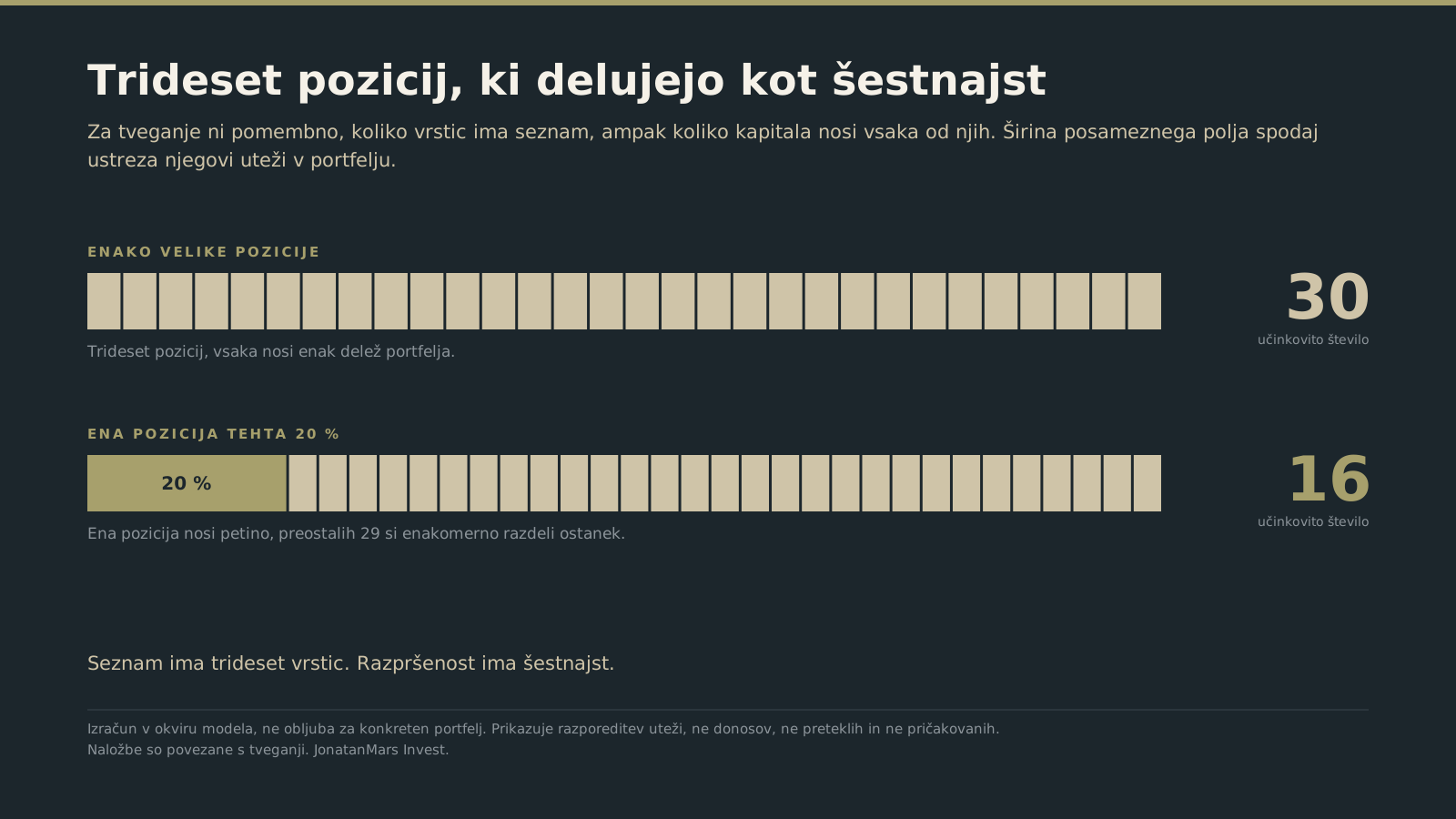
Weights. Risk depends not on the number of securities, but on how much capital each carries. Thirty equal positions behave like thirty. If one position weighs 20 % and the remaining 29 share the rest equally, a simple calculation gives the portfolio an effective diversification of about 16 equal positions. The nominal count can materially overstate diversification. Morningstar described a related lesson for funds in June 2026. Portfolios holding similar stocks can have very different concentration, sector and geographic exposures because their weighting rules differ.
Industry and geography. Companies in one industry share demand, regulation and costs, so twenty stocks in that industry do not represent twenty independent bets. The same applies to countries. A long list of securities from around the world does not guarantee an even allocation of value, as the opening example shows. Apparently different stocks can also lean towards the same return factors, as Fama and French documented in the US market.
Company size. Smaller companies carry more company-specific risk, so more of them are needed for the same diversification effect. A smaller-company portfolio needs its own analysis and evidence, not a number borrowed from studies of large stocks.
Nothing here undermines the case for broad index funds. Quite the opposite. A broad fund removes almost all single-company risk at very low cost. What remains is the composition of the market itself, including its current concentrations. That is not a flaw in the fund; it is its purpose. Vanguard offers a useful thought experiment. If we remove the investment that most recently underperformed from a diversified portfolio each time, the logic eventually leaves a single stock, the latest winner. Diversification accepts that we do not know in advance which country, industry or company will lead the next decade.
The useful question is not how many investments a portfolio holds. Ask what it actually owns, how much value sits in its largest positions, which countries and industries dominate, and how all of those exposures move together during bad periods.
At JonatanMars Invest, we build portfolios around those questions: exposures and weights first, then the number of securities. We publish new articles on the Insights page. If you want to discuss how diversified your portfolio is, a no-obligation introductory consultation is the right place.
Are 25 to 30 stocks always enough?
No. That range can remove most single-company risk in a balanced portfolio diversified across industries. It does not remove market risk, protect against poor selection or necessarily suffice when the concern is a bad long-run outcome rather than volatility.
Is a fund with several thousand stocks poorly diversified?
Usually not. It removes single-company risk very effectively. It still reflects the composition of the market, which may be concentrated in one country or industry. That is not a flaw, but it is a reason to understand the fund's actual composition rather than only its security count.
Does diversification protect against a fall in the whole market?
No. Diversification reduces company-specific risk. When the whole market falls, diversified portfolios fall too. Investments can lose value, and an investor may receive less than they invested.
How can I tell whether my portfolio is truly diversified?
Look at weights, not the list. How much value sits in the ten largest positions? What is the largest single weight? Which countries and industries dominate? If the ten largest holdings carry one fifth of the portfolio, it is more concentrated than the total holding count suggests.
Is it better to own 30 carefully selected stocks or a broad index fund?
Either can make sense. The answer depends on goals, costs, tax circumstances and whether stock selection deserves confidence. A general article cannot give personal advice. A consultation is the right place to discuss your case.
This is a marketing communication and general educational material, not personal investment advice.
Investing involves risk. The value of investments may fall as well as rise, and you may receive less than you invested. Past and any simulated or tested returns are not a reliable indicator of future returns. Tax treatment depends on personal circumstances and applicable law, both of which may change.
More insights

How to distinguish an attractive backtest from a result that is reproducible, robust and investable after costs.

Volatility is useful, but it does not capture permanent loss, liquidity, inflation or rare events. A smooth chart is not proof of safety.

What value, momentum and quality measure, why they may persist, and why each can disappoint for years.
Stay in touch