How many stocks make a diversified portfolio?
A stock count alone does not tell you how diversified a portfolio is. Weights, shared exposures and behaviour during bad periods matter too.
Imagine an investment whose value barely moves from one month to the next. The chart is smooth, the reports are calm, and the experience feels reassuring. Most people would call it a safe investment.
That conclusion can be an expensive mistake. A smooth chart tells you only how measured prices moved. It does not tell you whether you can lose money permanently, whether you will be able to withdraw it when you need it, or what it will buy in ten years. Volatility is useful, but it measures only one dimension of risk.
Volatility shows how far an investment's returns tend to move from their average. In 1952, Harry Markowitz showed how variance can measure the spread of returns and covariance their tendency to move together. Many portfolio models therefore use volatility as a proxy for risk. It is one measure of risk, not the whole picture.
It is a useful measure. When investments trade frequently, prices are observable and we compare the same periods, volatility describes the scale of ordinary movements and how investments interact inside a portfolio. Building a careful portfolio would be much harder without it.
The problem begins when volatility becomes the whole story. Anything that a measured price misses, or reveals too late, remains outside the picture.
In his memo Risk Revisited Again, American investor Howard Marks of Oaktree Capital defines risk mainly as the possibility of permanent capital loss. There are two routes to it. First, an investor sells during a fall, often under financial or emotional pressure, and turns a decline that might have recovered into a final loss. Second, the investment never recovers because its fundamentals have deteriorated.
The uncomfortable part is that we often cannot tell which is happening while prices are falling. Recovery is not guaranteed. It is wrong to say that every loss is temporary until we sell. Sometimes it is. Sometimes it is not.
This is also why volatility is not irrelevant. Marks acknowledges that price swings can cause harm when they force a sale, trigger a poor emotional decision or coincide with a need for cash. Volatility does not create the loss by itself. It matters when it pushes you into a decision you would not otherwise make.
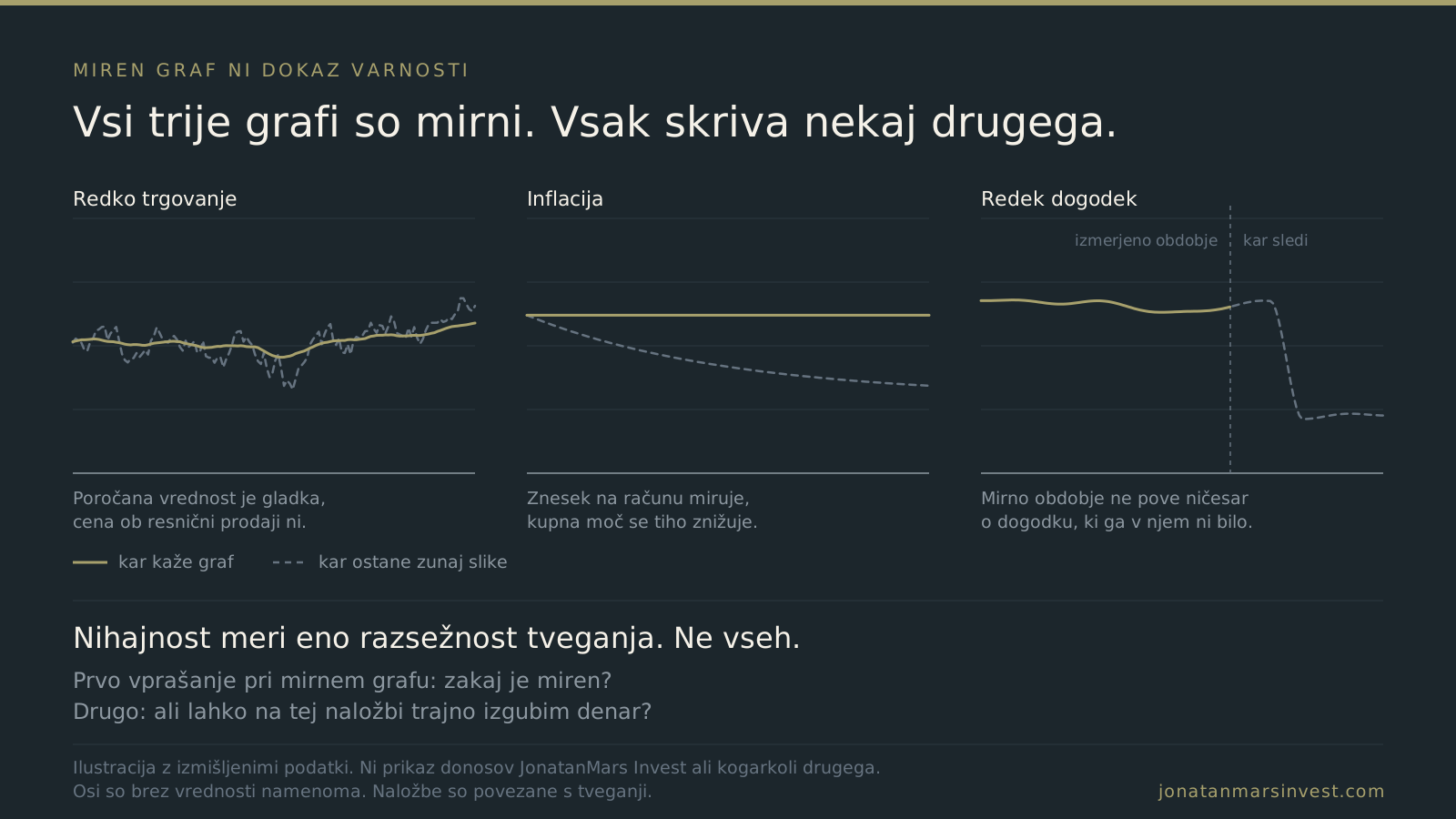
Some investments look calm because they trade infrequently or are valued using estimates rather than market prices. Research by Getmansky, Lo and Makarov showed that this kind of valuation can make measured volatility look lower than it really is. Risk measures then look better than the underlying investment deserves. The chart reflects the valuation method, not the investment itself.
Liquidity is central here. The Bank for International Settlements describes a liquid market as one in which an asset can be sold quickly, at low cost and close to the current market price. It also warns that liquidity can deteriorate during stress. Private funds can present a more ordinary version of the same problem: capital calls continue while distributions slow, so an investor who needs cash may have to sell below the estimated value. A stable estimate tells you little about the price available in a real sale.
Cash in an account has the smoothest chart of all because its nominal amount does not move. Inflation still reduces what that money can buy. The European Central Bank targets 2 % inflation because price stability protects purchasing power. This is not an argument against a cash reserve, which has an important role. It is a reminder that "nothing is happening" is not the same as "I am taking no risk."
Benoit Mandelbrot showed as early as 1963 that large market moves happen more often than a normal distribution predicts. A standard deviation calculated from a calm period tells us nothing about an event that did not occur during that period.
Nassim Taleb adds the question of decision-making. His point is not that models are useless. It is that estimates are least reliable where extreme outcomes matter most, for example when leverage is involved. A sensible question is not only "what is the probability of loss?" but also "what happens to my portfolio if the risk model is wrong?"
Morgan Housel makes a similar point without statistics. Risk depends on the probability that an event affects us and on the possible range of consequences. A rare event with destructive consequences deserves more attention than a frequent but mild one.
For many people, the most important risk is not volatility. It is the chance that their wealth will not do what they need it to do. Economist A. D. Roy described risk in 1952 as the probability that an outcome falls below a necessary minimum. Marks gives practical examples: a pension fund with payment obligations, or an investor who lives from their assets. Even a very smooth portfolio may be unsuitable if it cannot meet those obligations.
This logic works only with a realistic goal. If you expect a very conservative portfolio to produce returns historically associated with the riskiest investments, the problem lies in the expectation, not the portfolio. An unrealistic wish does not make a conservative investment risky.
Elroy Dimson of London Business School captured risk in a line that Howard Marks often cites: "Risk means more things can happen than will happen." The future is not one path waiting to be guessed. Even carefully estimated probabilities can omit an outcome or assign it the wrong weight.
This leads to a simple principle of portfolio construction. A portfolio should survive a world in which the forecast is wrong. At JonatanMars Invest, we do not assess risk through a single measure. We first use a client's goals and circumstances to determine which portfolio is suitable for them. In the strategies we build with ETFs, diversification considerably reduces the risk of permanent loss, while liquidity is a basic investment-selection filter. Volatility remains important because we use it when building a portfolio that is genuinely suitable for the client.
We publish new articles on the Insights page. What these ideas mean for your particular portfolio belongs in a consultation, not in a general article.
Is volatility a poor measure of risk?
No. Volatility is useful because it measures ordinary price movements consistently and helps with portfolio construction. It becomes misleading only when treated as a complete definition of risk. It measures observed price movement, not permanent loss, liquidity, inflation or events absent from the historical data.
What is a permanent capital loss?
A loss from which the investment does not recover. It can arise when an investment fails for fundamental reasons or when an investor sells during a fall and locks in the loss. This is why the portfolio and time horizon should reduce the chance that you are forced to sell during a decline.
Does a fall in value mean I have lost money?
Not necessarily, but recovery is never guaranteed. Some declines prove temporary and others permanent, and it is often impossible to distinguish them while they are happening. "Can this investment recover, and why?" is more useful than "How much did it fall this week?"
Is an investment that barely moves safe?
Not necessarily. A smooth chart may reflect infrequent trading or estimated valuations rather than genuine stability. Cash is perfectly smooth in nominal terms, but inflation reduces its purchasing power. Before investing, ask why the chart is smooth.
What is liquidity risk?
The risk that you cannot sell an investment quickly, cheaply and close to its recorded value when you need the money. It is often invisible in calm markets and can deteriorate precisely when you need liquidity most.
How much risk is suitable for me?
A general article cannot answer that. It depends on your goals, obligations, time horizon and ability to tolerate price swings. That calls for a conversation with an adviser, not a general rule.
This is a marketing communication and general educational material, not personal investment advice.
Investing involves risk. The value of investments may fall as well as rise, and you may receive less than you invested. Past and any simulated or tested returns are not a reliable indicator of future returns. Tax treatment depends on personal circumstances and applicable law, both of which may change.
More insights

A stock count alone does not tell you how diversified a portfolio is. Weights, shared exposures and behaviour during bad periods matter too.

How to distinguish an attractive backtest from a result that is reproducible, robust and investable after costs.

What value, momentum and quality measure, why they may persist, and why each can disappoint for years.
Stay in touch